
SB34 is a Brussels based non-profit organization providing qualitative and affordable artistic production studios, workshops and equipment. We also manage exhibition spaces in which local, international artists and art workers are invited to connect and collaborate to enhance the long term means of production, visibility and sustainability.
ABOUT SB34
CONTACT
ONGOING AND UPCOMING PROJECTS
PAST PROJECTS
︎ SB34 The Pool
Rue Saint Bernard, 34
1060 — Saint Gilles
Ongoing & Upcoming
— group exhibition
︎ SB34 Manchester
Rue de Manchester, 5-7
1080 — Molenbeek Saint-Jean
Ongoing & Upcoming
—
Rue Saint Bernard, 34
1060 — Saint Gilles
Ongoing & Upcoming
— group exhibition
MINIMAL PROCESSES OF CHANGE, 04.09 – 29.11.2026
︎ SB34 Manchester
Rue de Manchester, 5-7
1080 — Molenbeek Saint-Jean
Ongoing & Upcoming
—
︎ SB34 concorde
Rue de la Concorde, 16
1050 — Ixelles
Ongoing & Upcoming
— group exhibitionMINIMAL PROCESSES OF CHANGE, 04.09 – 29.11.2026, with Danae Io, Dóra Maurer, Margaret Raspé & Marie-Françoise Plissart
Rue de la Concorde, 16
1050 — Ixelles
Ongoing & Upcoming
— group exhibition
MINIMAL PROCESSES OF CHANGE, 04.09 – 29.11.2026, with Danae Io, Dóra Maurer, Margaret Raspé & Marie-Françoise Plissart
︎ Artist Studios
︎︎︎ THE POOL
Johnny Boy
Bravas Graphix
Steven Cruz
Charbon
Dalf
Julie DenisRaphaëlle Doineau
Blanche Taddei
Nele Wouters
︎︎︎ THE POOL
Johnny Boy
Bravas Graphix
Steven Cruz
Charbon
Dalf
Julie Denis
Raphaëlle Doineau
Nicolas Gutierrez Munoz
Sarah Juin
Julie Larrouy
Jacques Le Bourgeois
Anna Luz Pueyo
Anna Marguier
Sophie Martin
Rokko Miyoshi
Justin Sanchez
Nissrine Seffar
Marion Séhier
Blanche TaddeiThily Vossier
Leia WalzNele Wouters
︎︎︎ MANCHESTER
Clara Agnus
Estelle Chatelin
Théa Gonçalves
Eleanor Ivory Weber
Miki Kray
Yuna Mathieu-Chovet
Leïla Pile
Laura Stellaci
Everaert Verlinden
Rafael Vogel
info@sb34.org
Newsletter


SB34 is a Brussels based non-profit organization providing qualitative and affordable artistic production studios, workshops and equipment. We also manage two exhibition spaces in which local, international artists and art workers are invited to connect and collaborate to enhance the long term means of production, visibility and sustainability.

︎ SB34 concorde
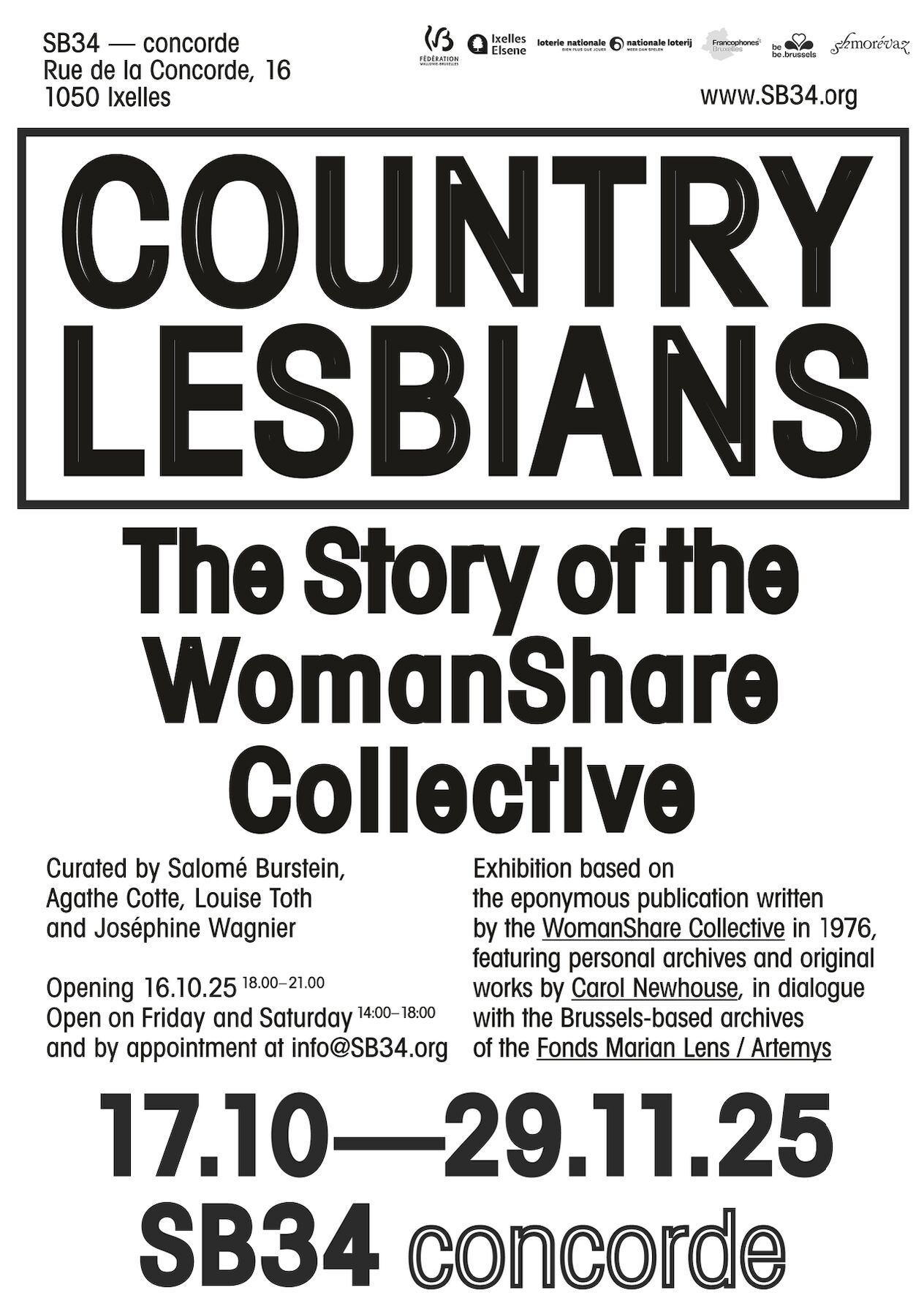
COUNTRY LESBIANS: THE STORY OF THE WOMANSHARE COLLECTIVE
Carol Newhouse, WomanShare Collective, Marian Lens/Artemys Funds
curated by Salomé Burstein, Agathe Cotte, Louise Toth & Joséphine Wagnier
17.10 — 29.11.2025 > 6.12.2025
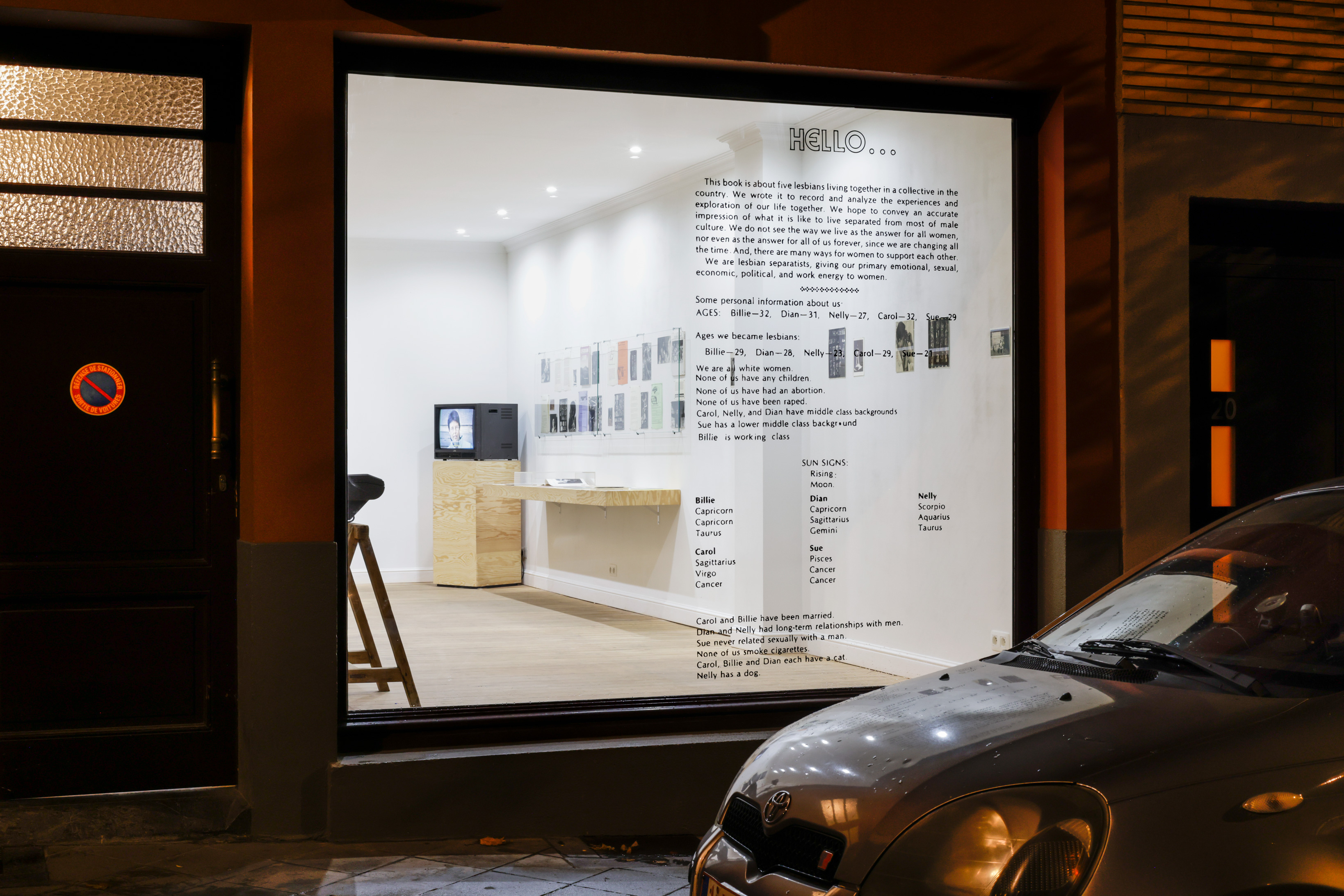
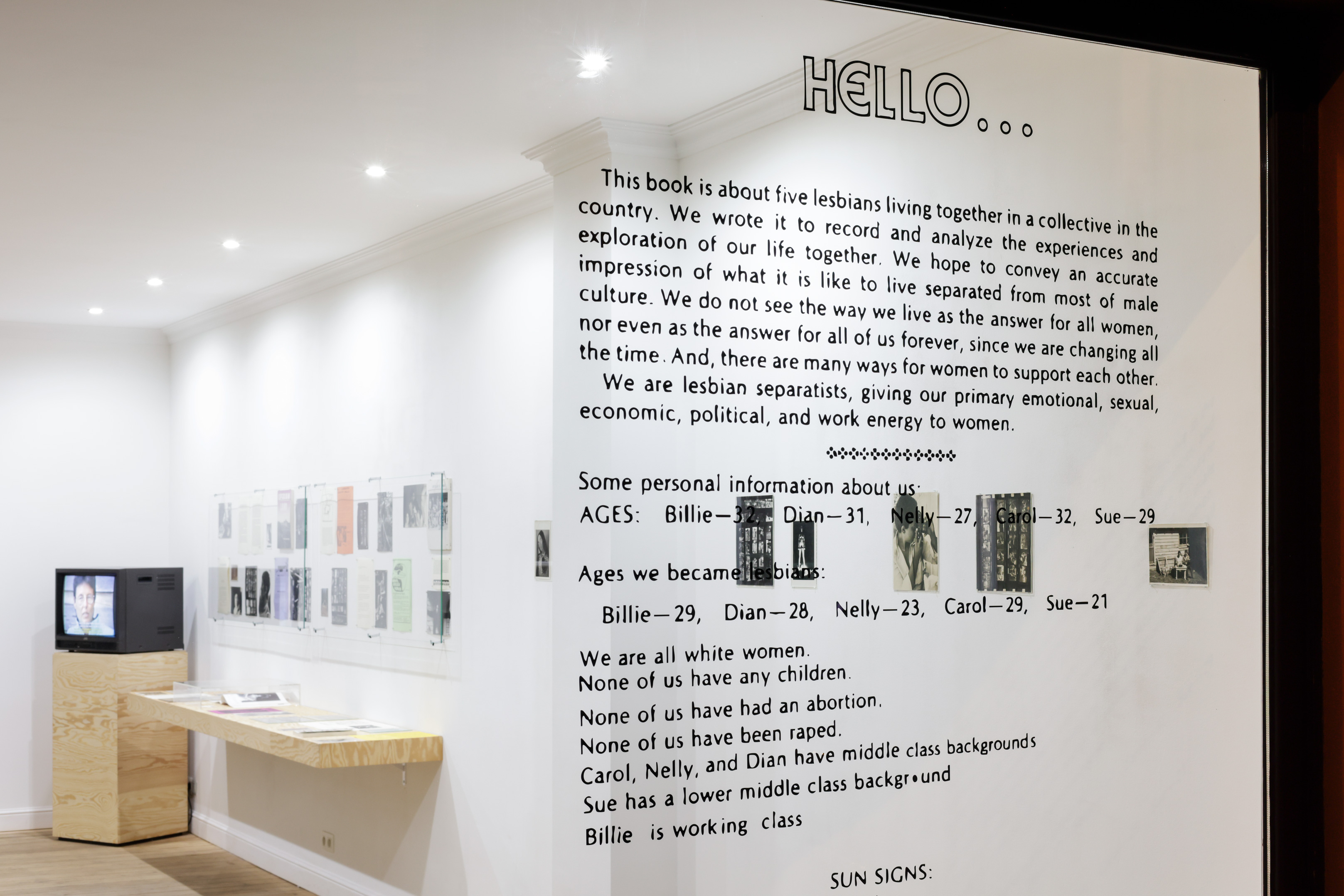
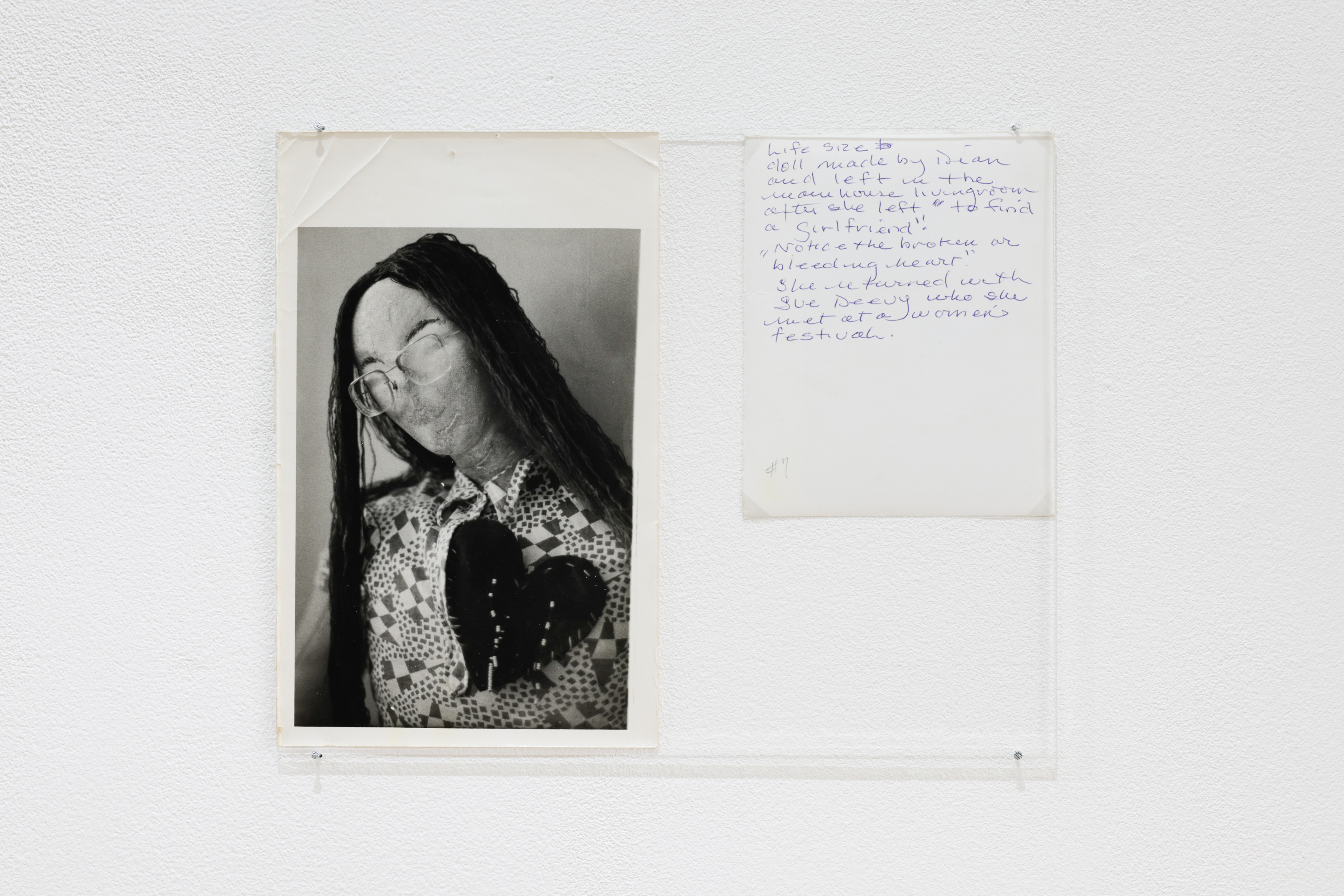
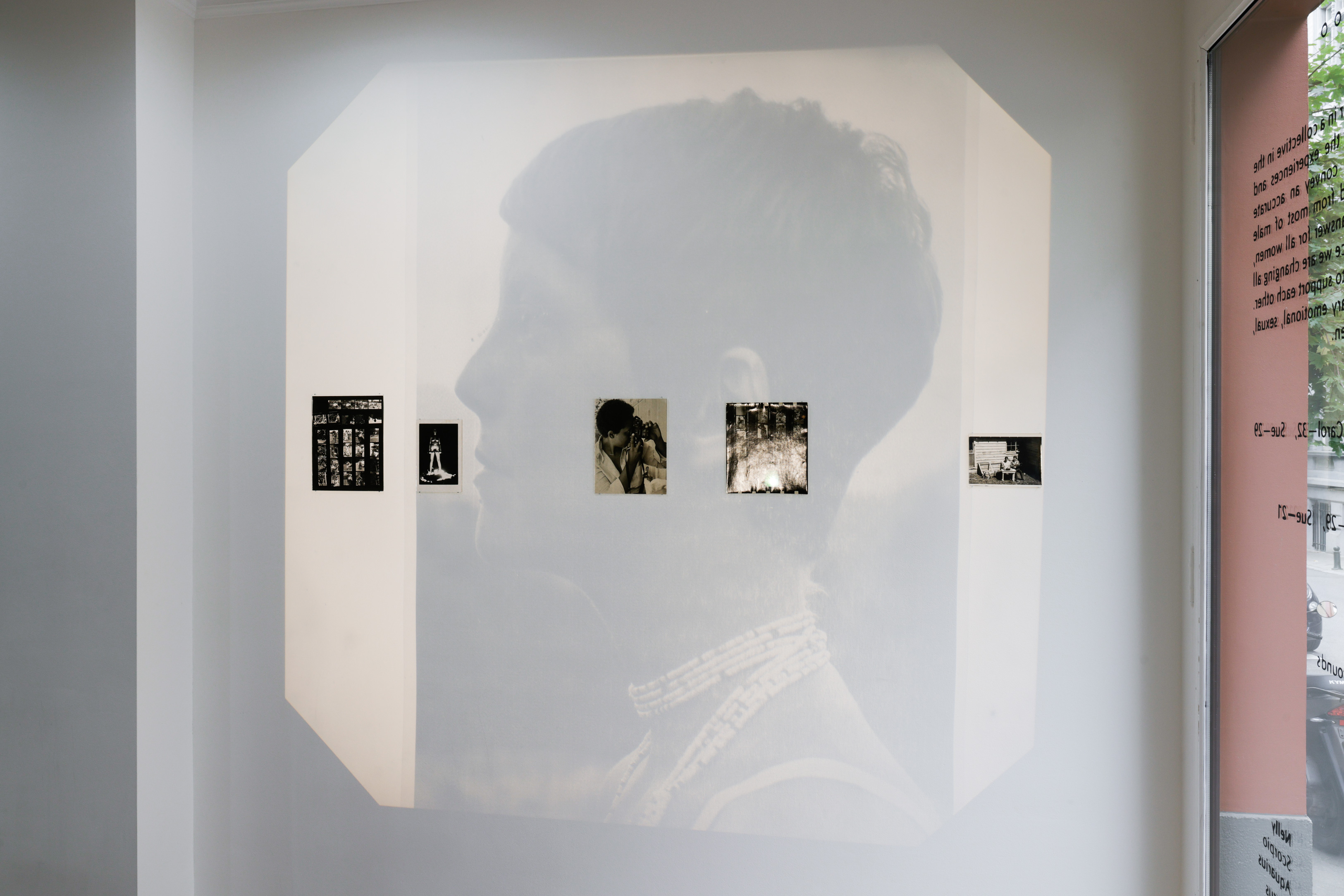
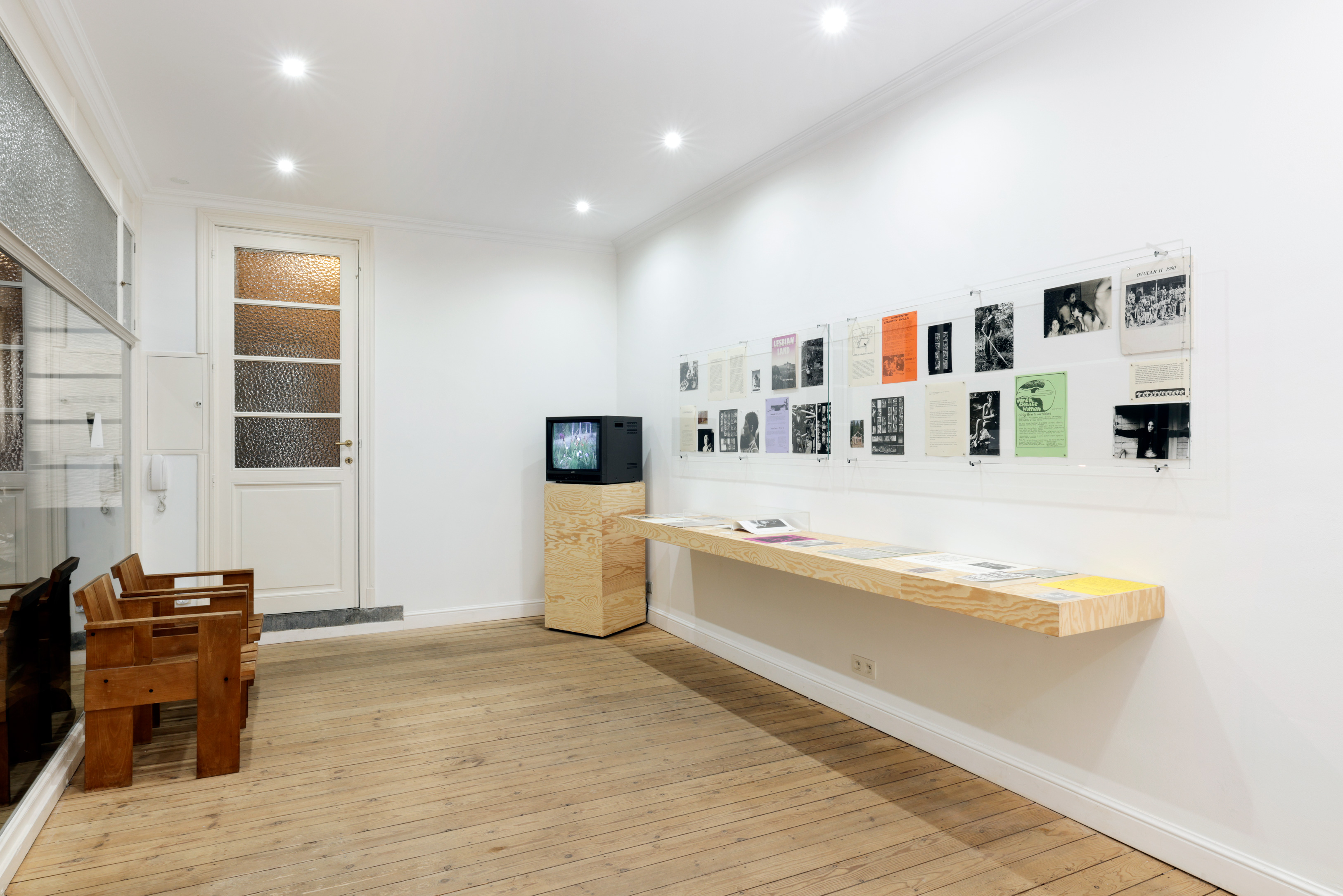
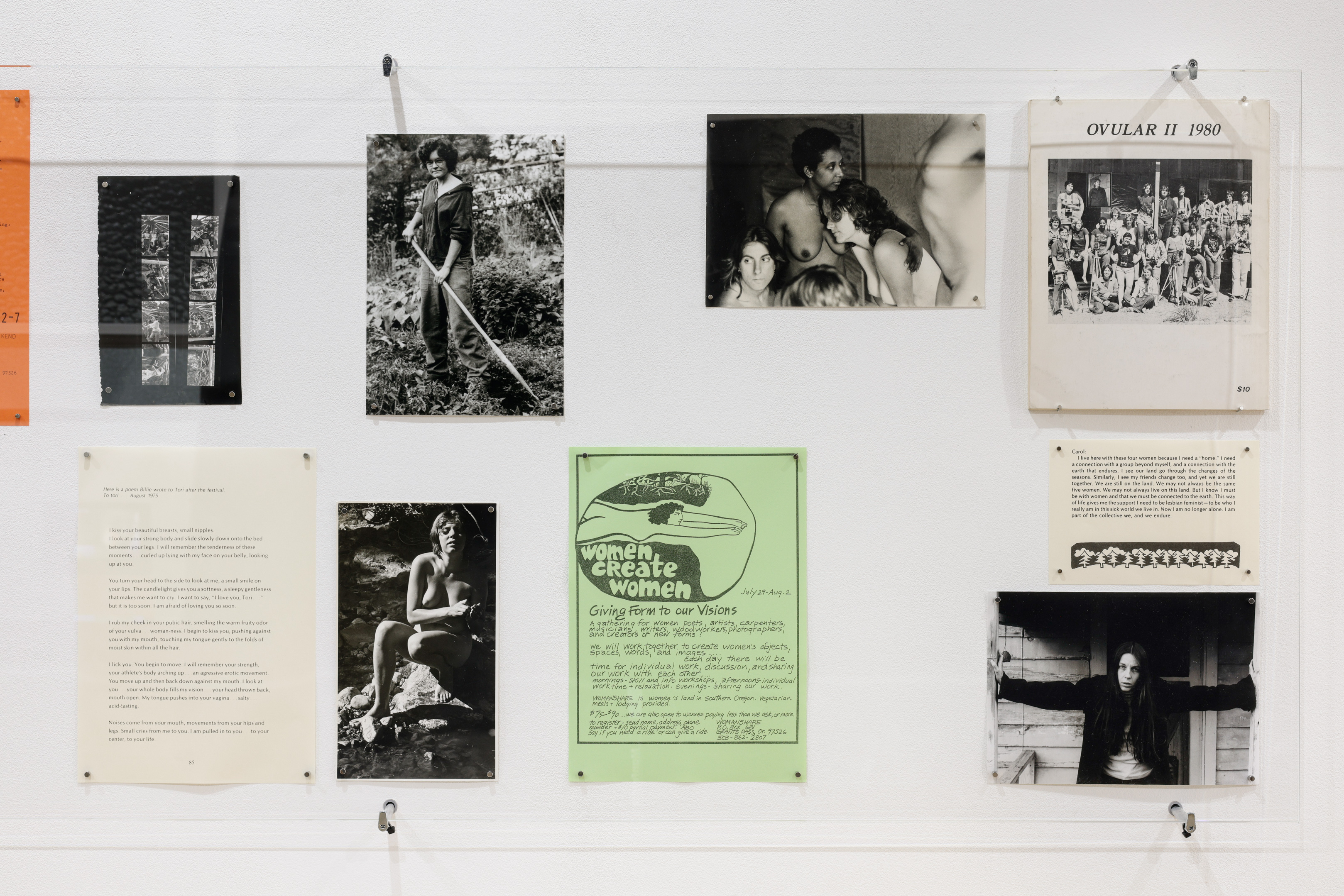
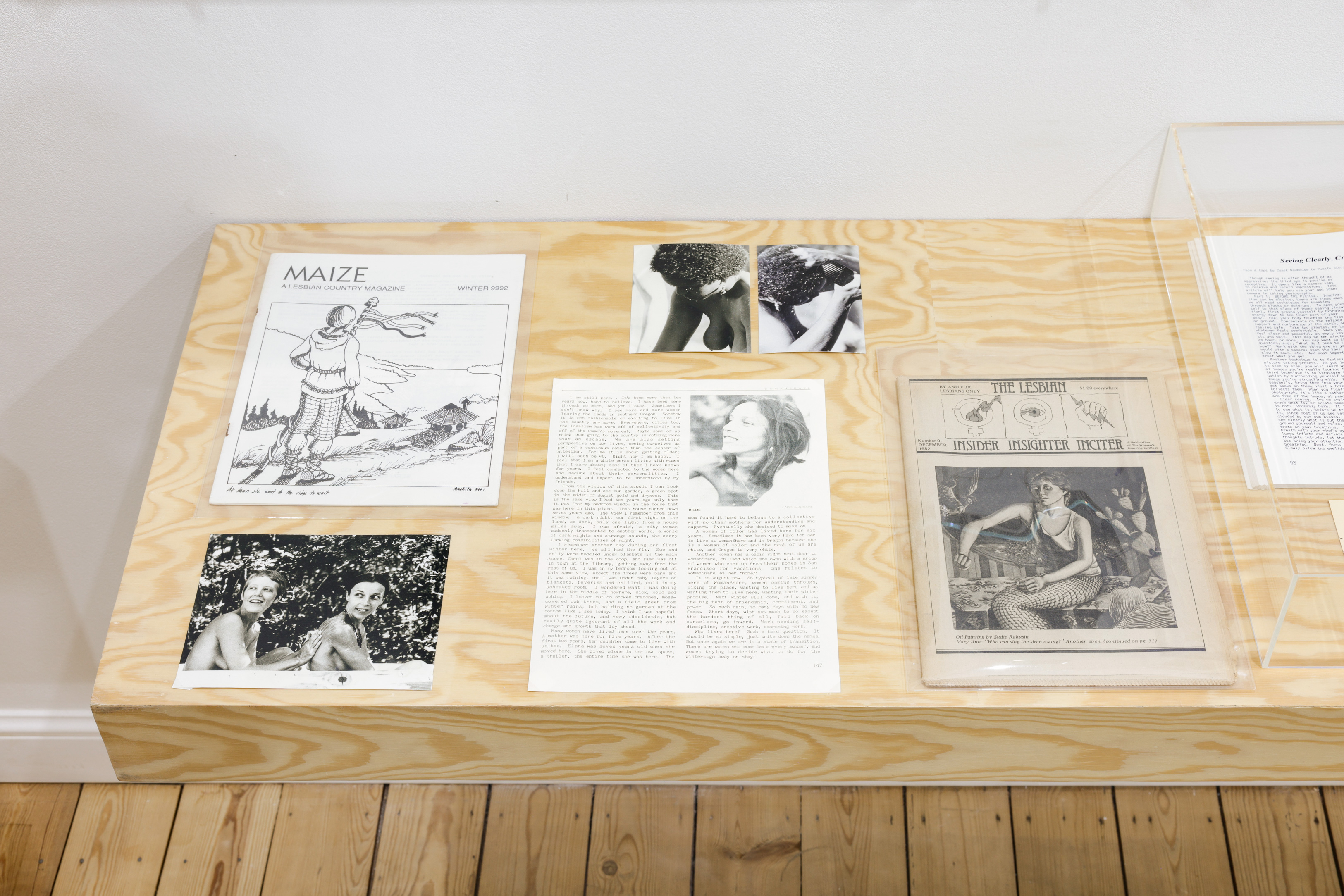
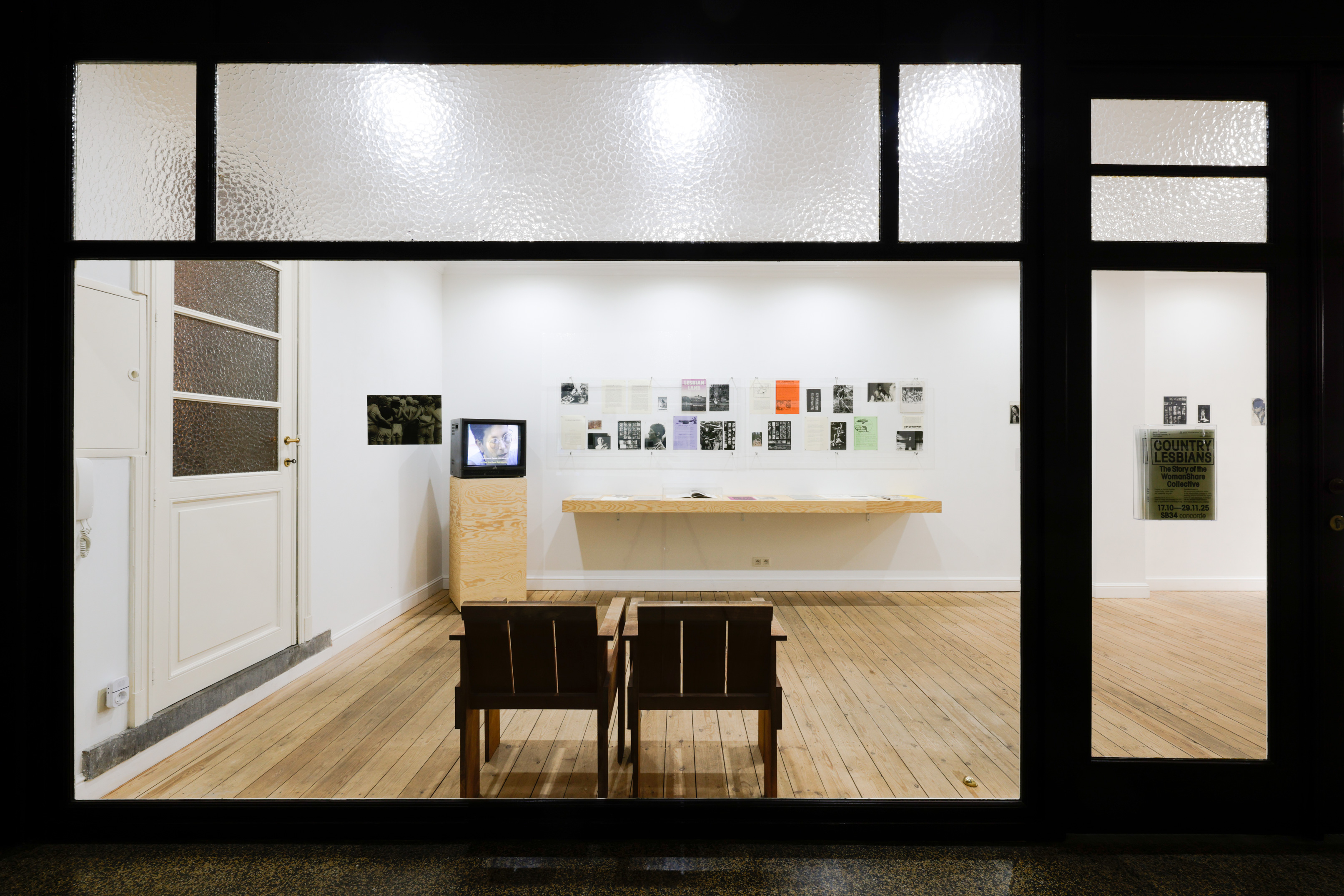
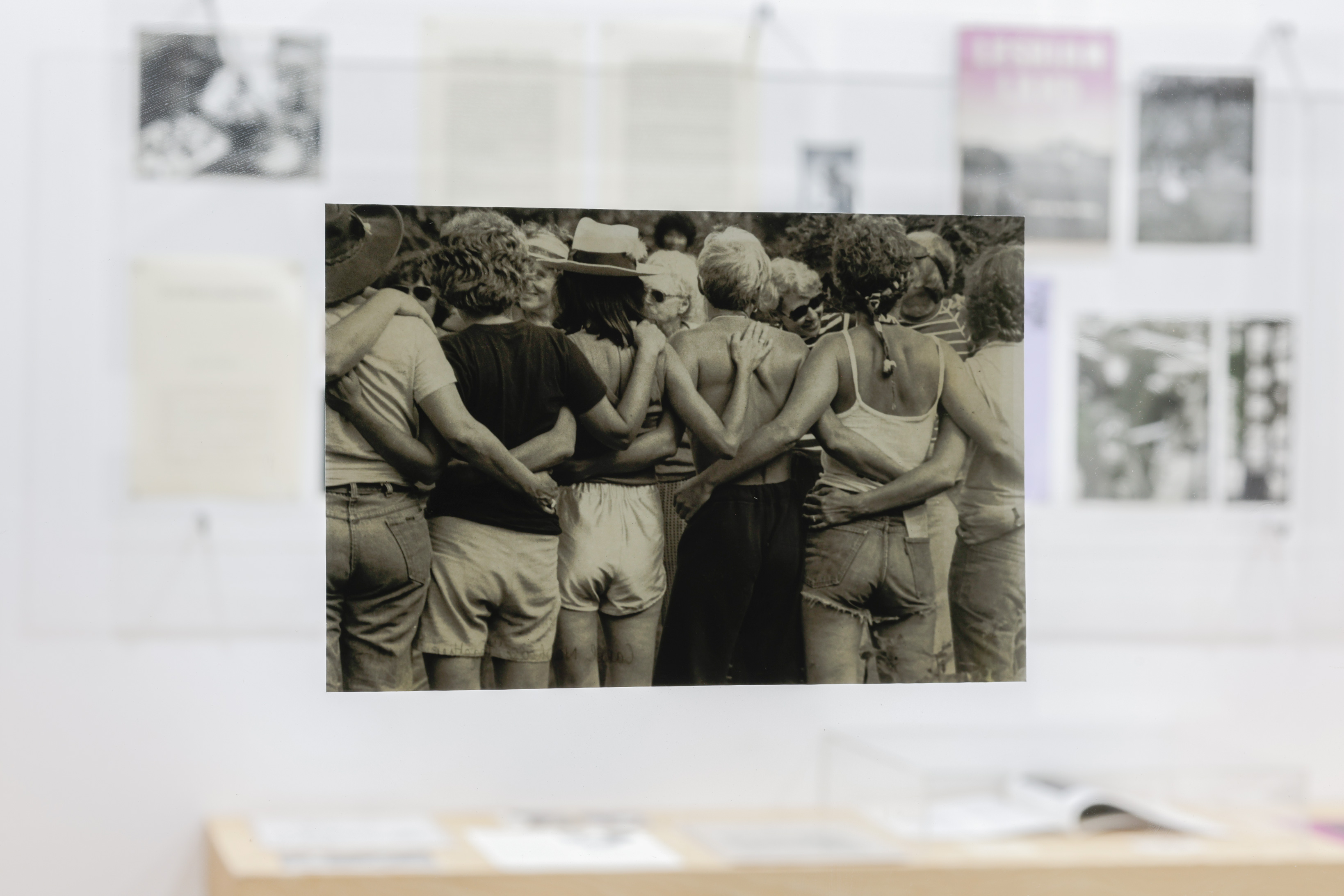
In the summer of 1973, Billie, Carol and Dian, looking to escape the masculine and patriarchal culture of the big city, went on a road trip. Drawn by a desire to return to the land and the conviction that women must find new ways of living together, they left Montreal and headed west, crossing the United States by car until they reached southern Oregon. The independence and isolation they found in rural life allowed them to assert themselves as feminists and lesbians: “Not back to the land, but back to ourselves.” In 1974, they bought their parcel of land and founded WomanShare, a separatist community where they independently lived, built, grew crops and wrote. Taking its title from a book co-written in 1976 by the members of WomanShare, the exhibition Country Lesbians: The story of the Womanshare Collective retraces this herstory. Through archival images, period flyers and magazines, snapshots of intimate moments, and artistic experiments, the exhibition revisits the exploration of new, collective ways of life that animated the 1960s and 1970s, while taking us into the heart of a collective and feminist practice.
First mounted in autumn 2024 at Shmorévaz –an independent exhibition space based in Paris– Country Lesbians is now travelling to SB34 concorde for its first showing in Belgium. The project is a collective effort led by Salomé Burstein – independent curator and founder of Shmorévaz, Louise Toth –researcher specialising in collective and visual practices– and Agathe Cotte –artist whose work focuses on editorial practices. The invitation, exhibition and programme at SB34 were curated in collaboration with Joséphine Wagnier, coordinator at SB34. For its Ixelles chapter, the WomanShare archives are complemented by the Marian Lens/Artemys collection, providing an insight into the international perception of lesbian communities in Oregon.
︎ EXHIBITION TEXT
The exhibition looks back at the legacy of communities born out of separatist lesbianism, a movement at the intersection of radical feminism and political lesbianism. Originally, the movement aimed to offer a better way of life to the women who joined it, rejecting all relationships with men in order to escape heteronormativity as a political system and to bring about an autonomous lesbian culture.
From the 1970s onwards, separatist lesbianism often took the form of small, self-governing rural communities, and there were many of these on the West Coast of the United States. These communities developed within an ecosystem consisting of a wide variety of small feminist businesses –bookshops, presses, cultural centres and women’s houses– whose network spread through printed communications promoting women-only spiritual retreats, art workshops, worksites and festivals. Fully inhabiting the activist and cultural sphere of the time from their marginal positions, the members of these communities also played a central role in the production of literary and artistic journals.
To ensure their circulation and foster networks, they relied on solidarity-based distribution systems supported by feminist and lesbian bookshops, festivals and gatherings. These included Old Wives Tales (founded in 1976 in San Francisco, USA) and, on the other side of the Atlantic, Brussels’ first openly lesbian bookshop, Artemys (1985–2002, Ixelles), run by Marian Lens, who is now working at archiving the memory of this space and the activist history that preceded it. The publications that reach us today are thus a testament to these spaces of exchange, exploration and self- and collective expression.
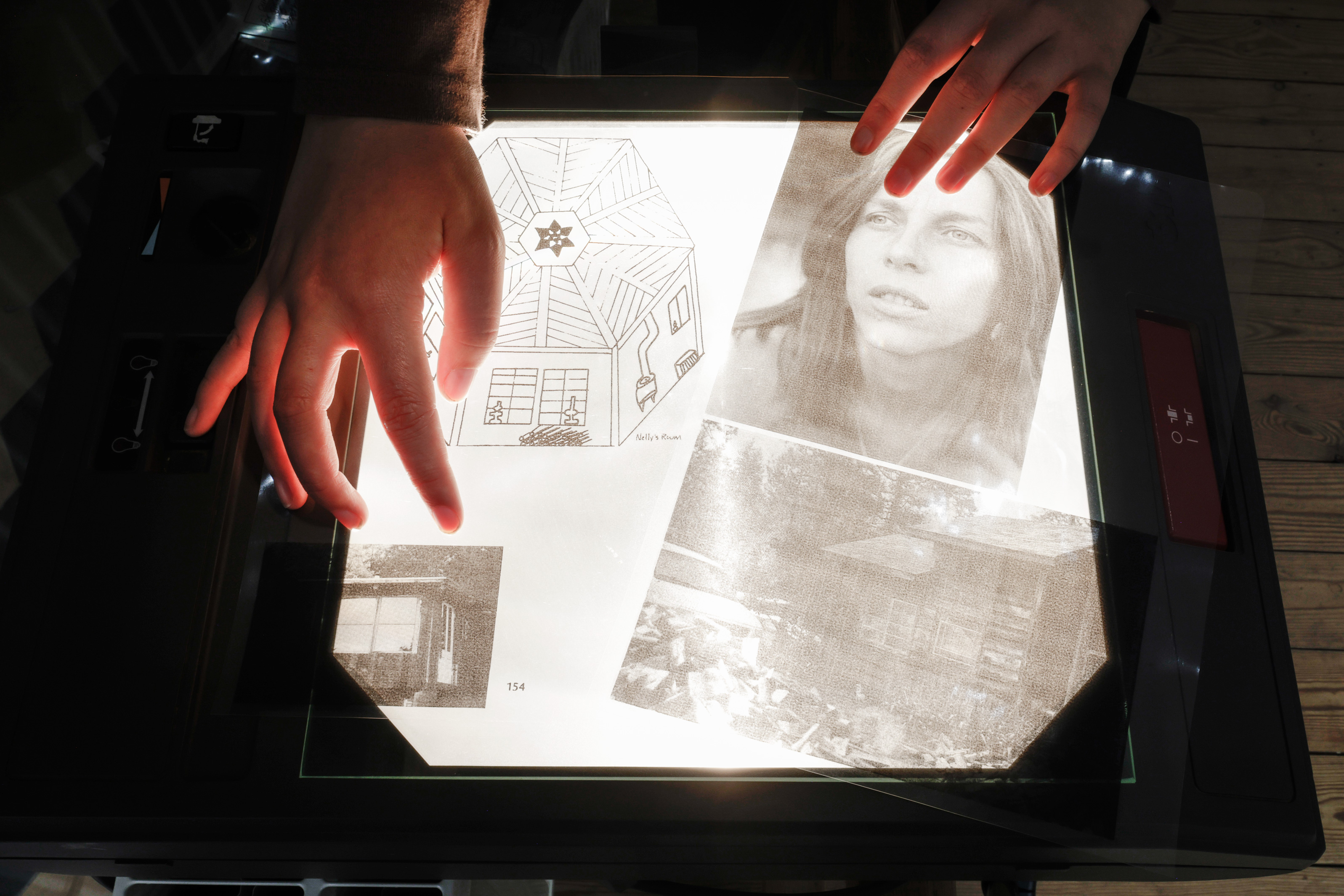
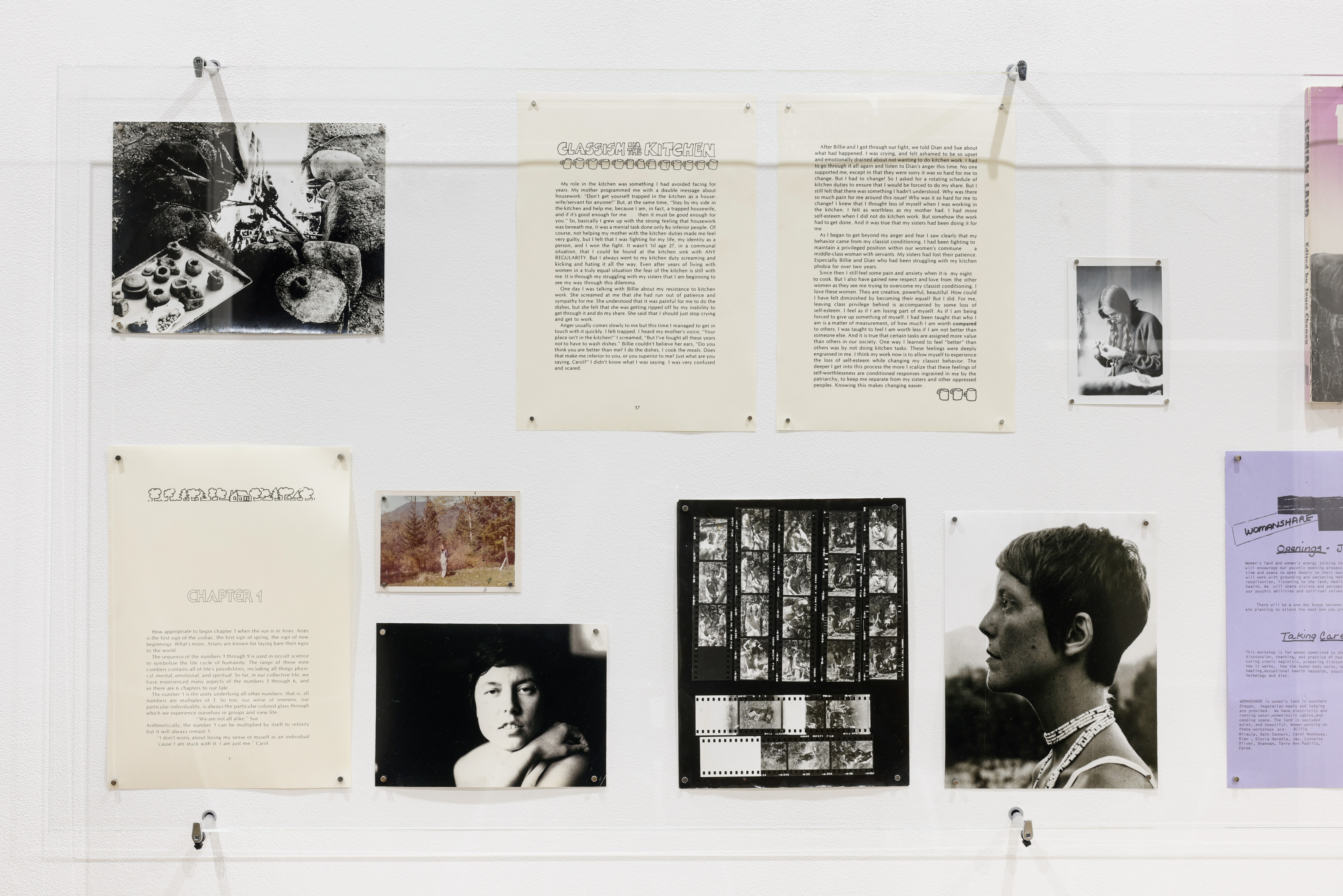
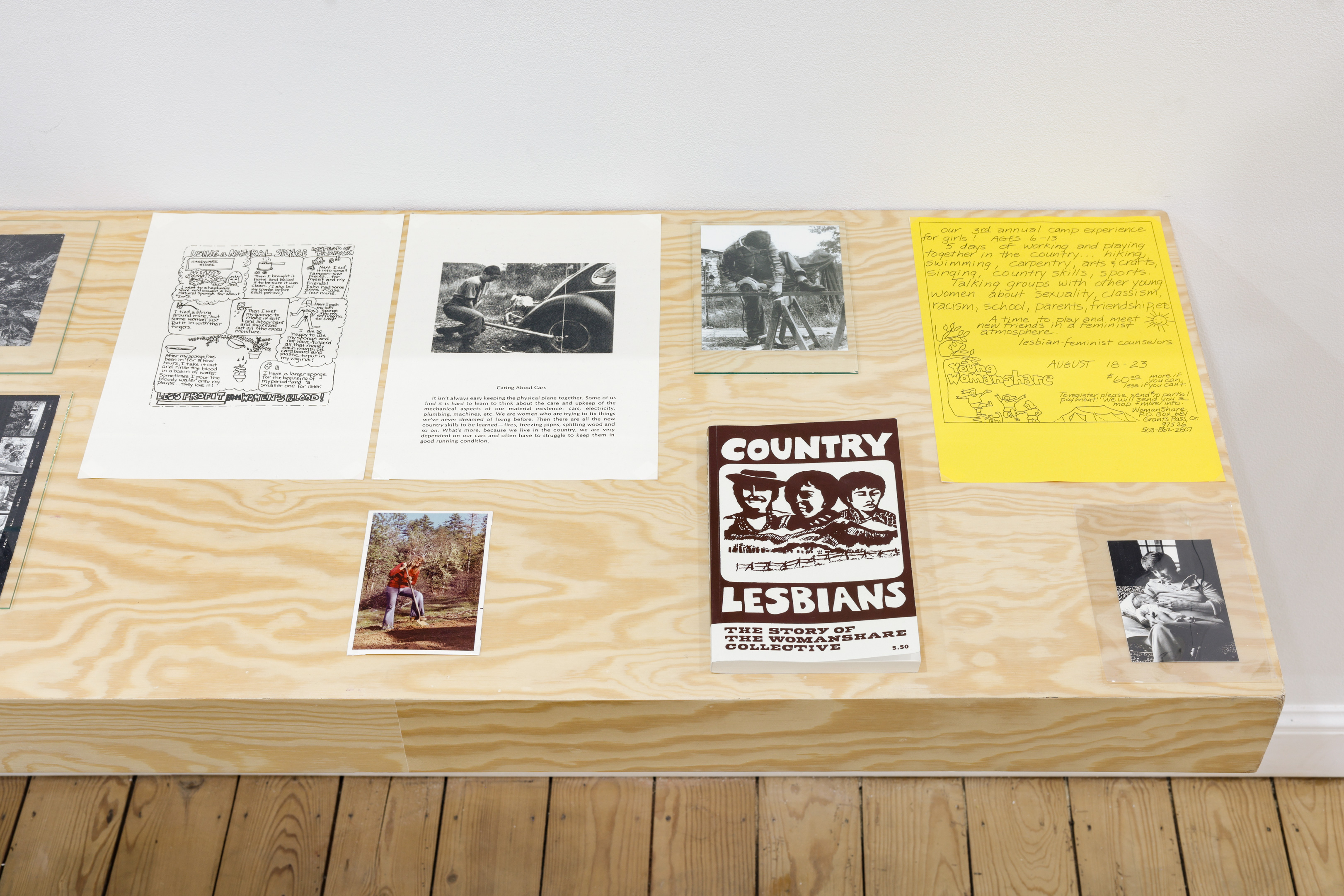
Returning to this heritage is a necessary political act, as it is such a valuable resource and tool for imagining other ways of living, organising and creating collectively. Although they often diverged over their vision and ideology, the figures of separatist lesbianism and materialist feminists shared a strong conviction: it is not only possible, but vital, to imagine and build lives free from patriarchy and capitalism. Co-written by Sue Deevy, Nelly Kaufer, Billie Miracle, Carol Newhouse and Dian Wagner –founding members of WomanShare– Country Lesbians recounts such an endeavour. Far from being a simple archival document, the book acts as a guide, a literary and artistic object that in combining different registers and modes of expression, invites us to rethink our power relations, our relationship to work, property, the environment and forms of collective attention. Through stories of shared worksites, erotic poetry, comics, photographs of everyday life, and transcriptions of conflicts and their resolution, Country Lesbians: The story of the Womanshare collective shows how these women made another way of life possible.
Among the various lesbian lands that have existed, and those that still endure today, WomanShare stands out as a unique case, notable for its radicality and its will to rethink its purpose in a contemporary way, with the wish of enabling an intergenerational transmission. From a decolonial perspective and with the support of Carol Newhouse and Billie Miracle, the WomanShare holding has thus become Native WomanShare. The space is now run by Lycan El Lobo Coss and Bianca Fox Del Mar Baralla, who are working to make it a space of support for queer, two-spirit people of colour, honouring the legacy of their elders in the process of rematriating the land.
Salomé Burstein, Agathe Cotte, Louise Toth & Joséphine Wagnier
Translated by Jack Cox
Translated by Jack Cox
︎ TEXT BY CAROL NEWHOUSE
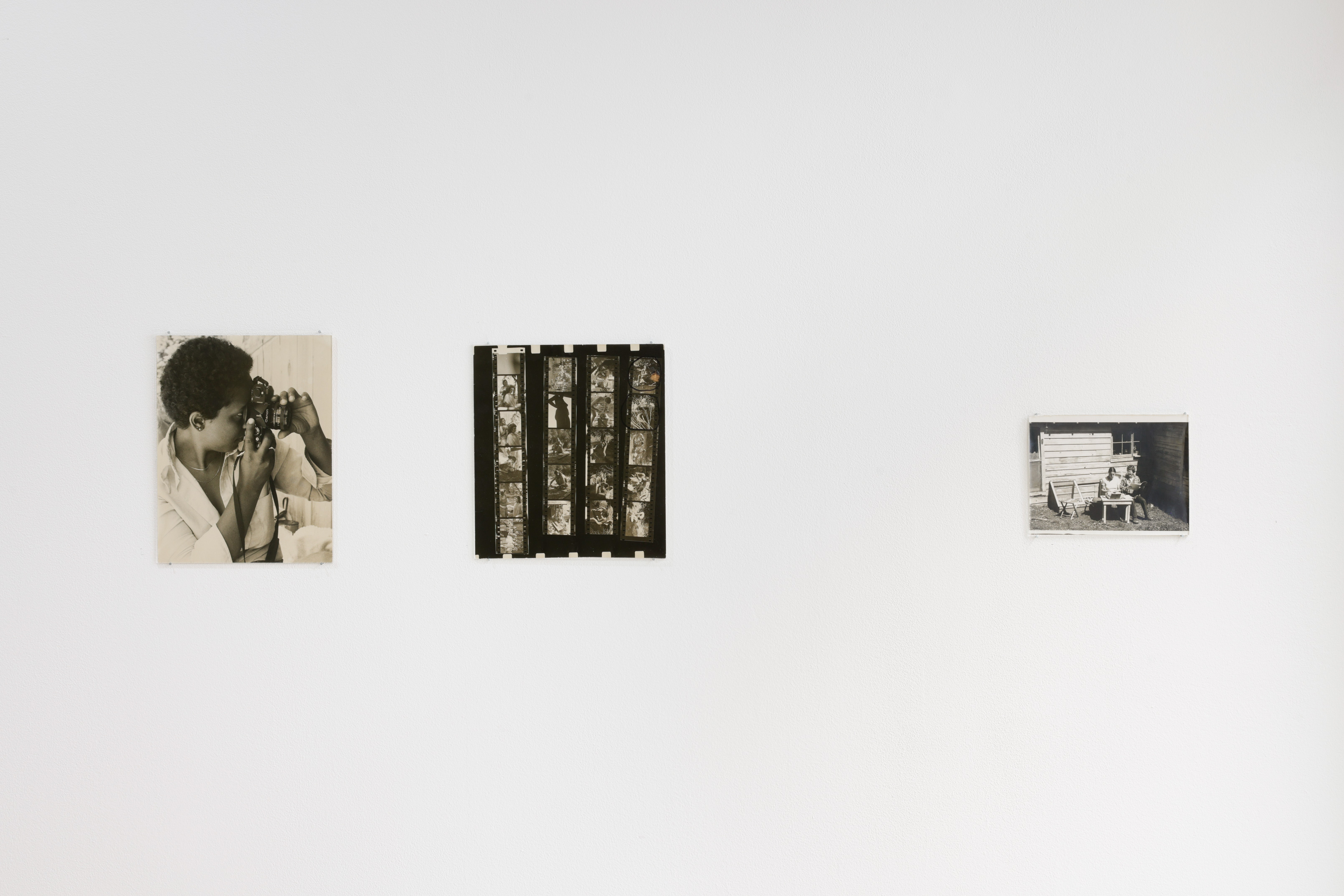
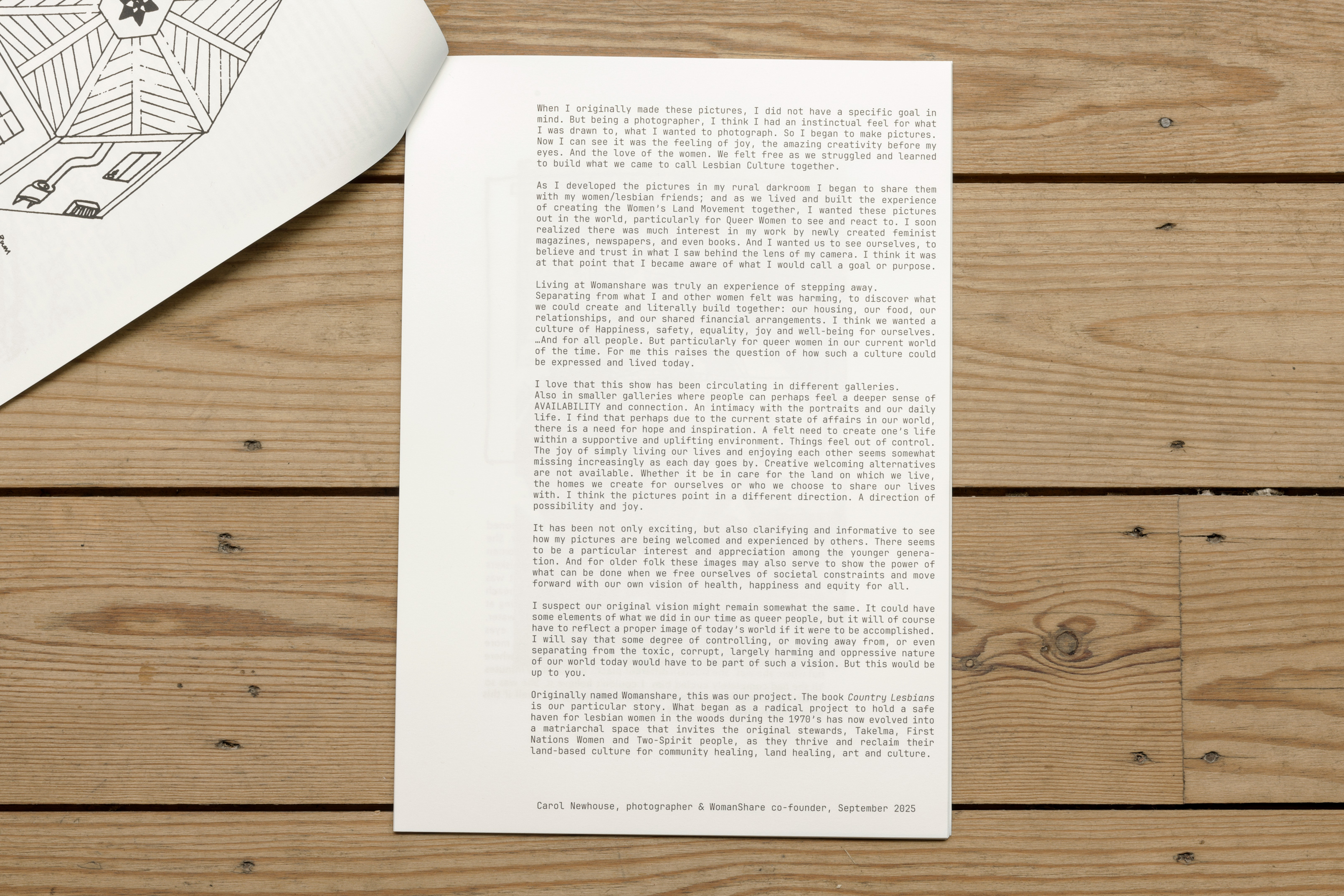
When I originally made these pictures, I did not have a specific goal in mind. But being a photographer, I think I had an instinctual feel for what I was drawn to, what I wanted to photograph. So I began to make pictures. Now I can see it was the feeling of joy, the amazing creativity before my eyes. And the love of the women. We felt free as we struggled and learned to build what we came to call Lesbian Culture together.
As I developed the pictures in my rural darkroom I began to share them with my women/lesbian friends; and as we lived and built the experience of creating the Women’s Land Movement together, I wanted these pictures out in the world, particularly for Queer Women to see and react to. I soon realized there was much interest in my work by newly created feminist magazines, newspapers, and even books. And I wanted us to see ourselves, to believe and trust in what I saw behind the lens of my camera. I think it was at that point that I became aware of what I would call a goal or purpose.
Living at Womanshare was truly an experience of stepping away. Separating from what I and other women felt was harming, to discover what we could create and literally build together: our housing, our food, our relationships, and our shared financial arrangements. I think we wanted a culture of Happiness, safety, equality, joy and well-being for ourselves.…And for all people. But particularly for queer women in our current world of the time. For me this raises the question of how such a culture could be expressed and lived today.
I love that this show has been circulating in different galleries. Also in smaller galleries where people can perhaps feel a deeper sense of AVAILABILITY and connection. An intimacy with the portraits and our daily life. I find that perhaps due to the current state of affairs in our world, there is a need for hope and inspiration. A felt need to create one’s life within a supportive and uplifting environment. Things feel out of control. The joy of simply living our lives and enjoying each other seems somewhat missing increasingly as each day goes by. Creative welcoming alternatives are not available. Whether it be in care for the land on which we live, the homes we create for ourselves or who we choose to share our lives with. I think the pictures point in a different direction. A direction of possibility and joy.
It has been not only exciting, but also clarifying and informative to see how my pictures are being welcomed and experienced by others. There seems to be a particular interest and appreciation among the younger generation. And for older folk these images may also serve to show the power of what can be done when we free ourselves of societal constraints and move forward with our own vision of health, happiness and equity for all.
I suspect our original vision might remain somewhat the same. It could have some elements of what we did in our time as queer people, but it will of course have to reflect a proper image of today’s world if it were to be accomplished. I will say that some degree of controlling, or moving away from, or even separating from the toxic, corrupt, largely harming and oppressive nature of our world today would have to be part of such a vision. But this would be up to you.
Originally named Womanshare, this was our project. The book Country Lesbians is our particular story. What began as a radical project to hold a safe haven for lesbian women in the woods during the 1970's has now evolved into a matriarchal space that invites the original stewards, Takelma, First Nations Women and Two-Spirit people, as they thrive and reclaim their land-based culture for community healing, land healing, art and culture.
Carol Newhouse, photographer & WomanShare co-founder,
September 2025
Text authored in conjunction with the exhibition
September 2025
Text authored in conjunction with the exhibition
︎ ABOUT
SALOMÉ BURSTEIN is an independent curator and writer based in Paris. Her current research looks into the entwinement of eroticism, attention economy, and entertainment culture. With an academic background in theater and visual studies (ENS Lyon, EHESS Paris, and Columbia University) and further investigations around collective practices (Royal Institute of Art, Stockholm), she has collaborated with several artistic institutions (AFIELD Fellowship, Lafayette Anticipations, Hauser & Wirth) and publications (Mousse, Texte zur Kunst, JRP, CURA) through exhibitions, texts, and translations. Burstein is the founder and director of Shmorévaz, an independent space for art and research located in a former shoe store in Paris, and the editor of Shmooks, its affiliated publishing platform.
AGATHE COTTE is an artist-publisher. Her practice comprises publishing, installation, graphic design and curatorial work and explores the relationship between text and image. Since 2020, she has been developing research on the memories of minorities, combining writing, fantasy archives and the circulation of marginalised narratives. The published object – its history, its uses and its forms – takes centre stage in her work.
LOUISE TOTH is a PHD candidate in gender studies at Université Bordeaux Montaigne (France). Their work focuses on collective and visual practices, especially within southern Oregon lesbian lands. In November 2024, they co-curated the exhibition “Country Lesbians” at Shmorévaz (Paris), along with an English republication of the eponym book published in 1975 by the WomanShare collective. They also participated in the translation and publication of the american lesbian separatist anthology The feminist movement is a lesbian plot (2025) by Rotolux Press.
Trained as a visual artist and curator, JOSÉPHINE WAGNIER defines herself as an art worker. Her practice oscillates between accompanying artistic/cultural projects, research, writing and exhibiting. Her current research engages with counter-gaze practices and perspectives, particularly those situated in rural contexts. In 2023 she was selected by the Young Curators Programme to accompany the petticoat government project at the 60th Venice Biennale. She is engaged as a polyvalent coordinator and mediator at SB34.
CAROL NEWHOUSE is an American photographer, writer, and educator, best known as a cofounder of the WomanShare Collective near Grants Pass, Oregon, and a key figure in the lesbian photography movement of the 1970s and 1980s. Her work, which has appeared in Amazon Quarterly, Blatant Image, WomanSpirit, and The Woman’s Carpentry Book (Doubleday, 1980), documents women’s communities and queer lives through an intersection of documentary and experimental portraiture. Drawing from feminist and ecological world-building, Newhouse’s photography explores gender expression, intimacy, and the human relationship to the natural world. She held an internship at the National Film Board of Canada (1969–1970), where she studied social justice documentary photography and video production, and has also worked for over three decades as a clinical social worker and educator.
︎ PUBLICATION
![]()
![]()
Collectively written by the members of WomanShare, this volume recounts their experience of communal living and intentional rupture: they established themselves as a separatist lesbian, self-governing group removed from patriarchal and capitalist structures of dominance and oppression in southern Oregon. They offer an intimately and transparently written work that can be read as a guide providing relational insights: how to balance class dynamics within a community, poetry as a method of communication, transcribed group conversations, illustrations, accounts of daily routines, and even pages of recipes and DIY tampon instructions.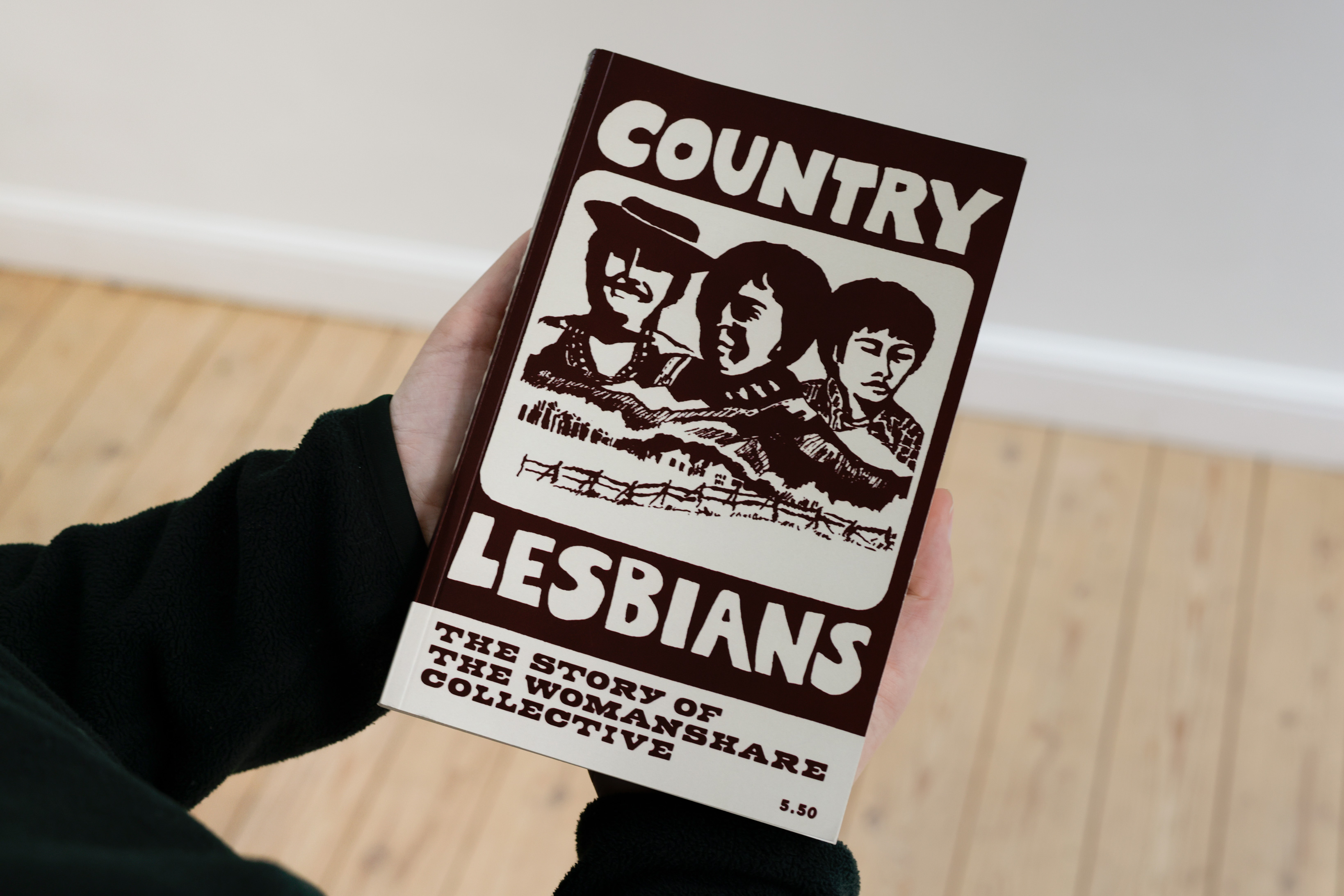
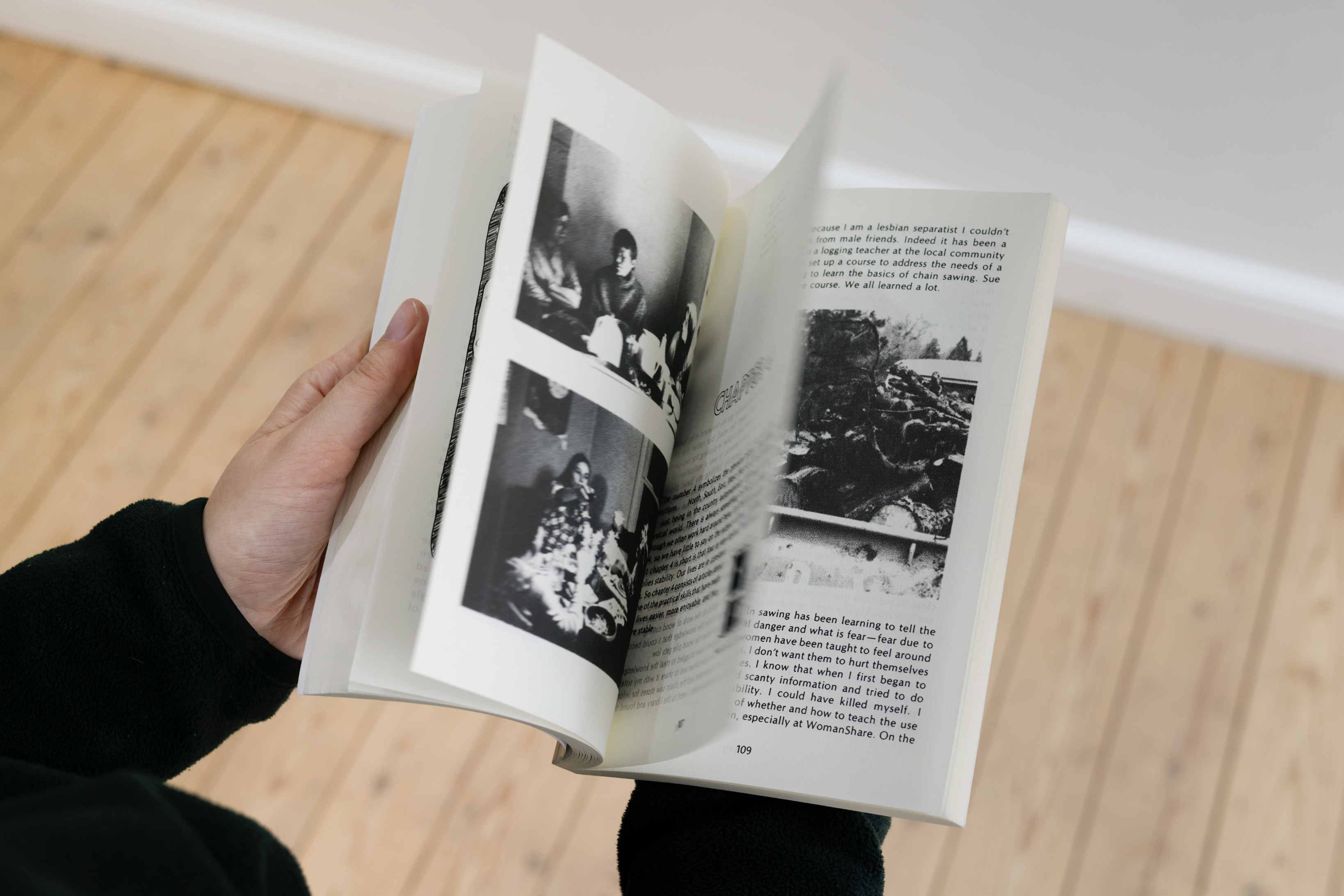
The original publication has been reissued and co-published by Espace Ness (Ness Books) and Shmooks (Shmorévaz publishing platform) as part of the exhibition of the same name. A French edition is currently in preparation and is scheduled for release in 2026.
For further information on the publication, please click here.
︎ PROGRAM
![]()
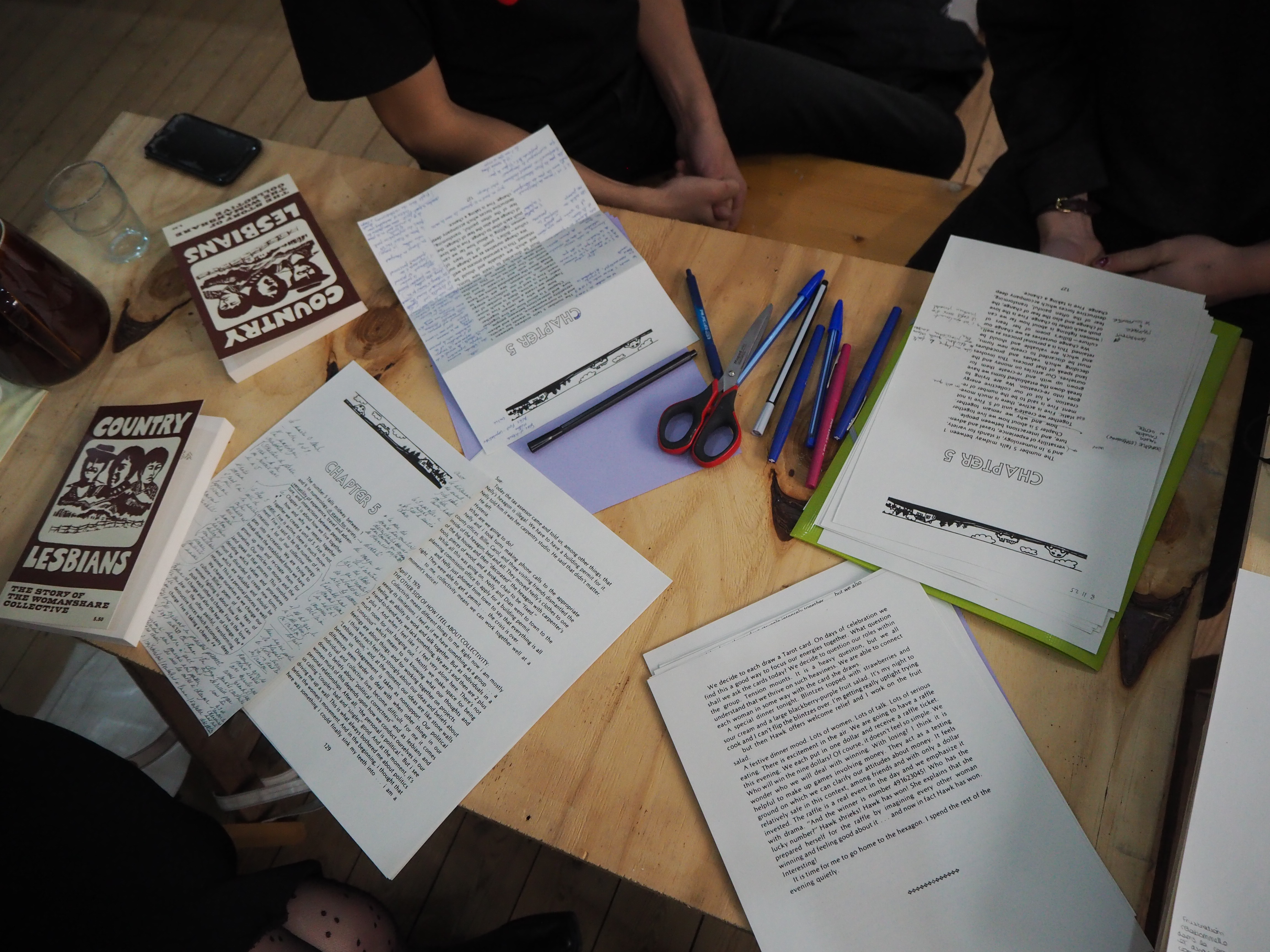
Translation workshop
WORKSHOPS
︎ Saturday, 8.11.2025, 10:30-13:30 - Workshop (FR/ENG) : Reading and Translating Country Lesbians
︎ Saturday, 22.11.2025, 10:30-12:30 - Workshop (FR/ENG) : Seeing Ourselves in the Archive / Lesbian Image Reading
at SB34 concorde / on RSVP at info@sb34.org
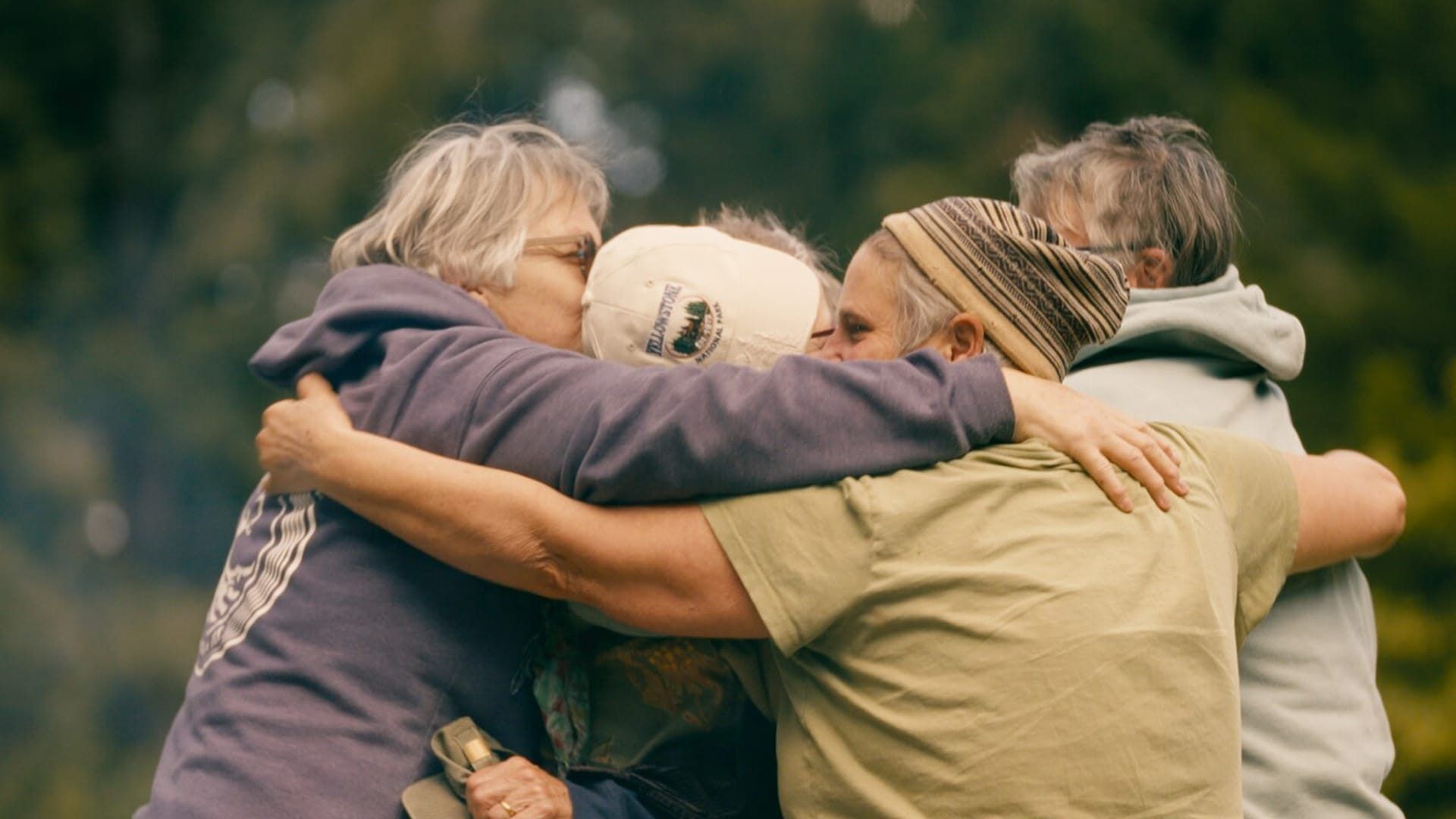
Excerpt from Beyond Eden, a work by Al Johnstone, projected during the conference at Arba-Esa
EVENTS
︎ Thursday, 20.11.2025, 18:00-20:30 - Talk and Film Screening (FR/ENG) : Legacy of the lesbian lands - Conversation with Louise Toth, Marian Lens & Joséphine Wagnier, screening of Beyond Eden (2025) with Al Johnstone present
Horta Auditorium / ArBa-EsA - Rue du Midi 144, 1000 Bruxelles
︎ Thursday, 27.11.2025, 18:00-20:00 - Talk and Share a drink (FR/ENG) : with Louise Toth & Joséphine Wagnier about the exhibition project, its process and their researches
Crazy Circle - Rue du Prince Royal 11, 1050 Ixelles
︎ Saturday, 29.11.2025, from 12:30 - Talk and Reading (FR) : With Salomé Burstein, Agathe Cotte & Louise Toth, during BRUSSELS ASS BOOK FAIR
K1 / Kanal Centre-Pompidou - Av. du Port 1, 1000 Bruxelles
BILINGUAL BOOKLET (ENG/FR)
Documented by © Fabrice Schneider
Avec le soutien de la Commission des Arts Plastiques de la Fédération Wallonie-Bruxelles, de la Commune d'Ixelles - Monsieur Romain De Reusme, Bourgmestre, Monsieur Gautier Calomne, 1er Échevin et Échevin de la Culture, Madame Nevruz Unal, Échevine de la Prévention, et des membres du Conseil communal-, de la Loterie Nationale, de la Cocof et de la Région Bruxelles Capitale en Image de Bruxelles.